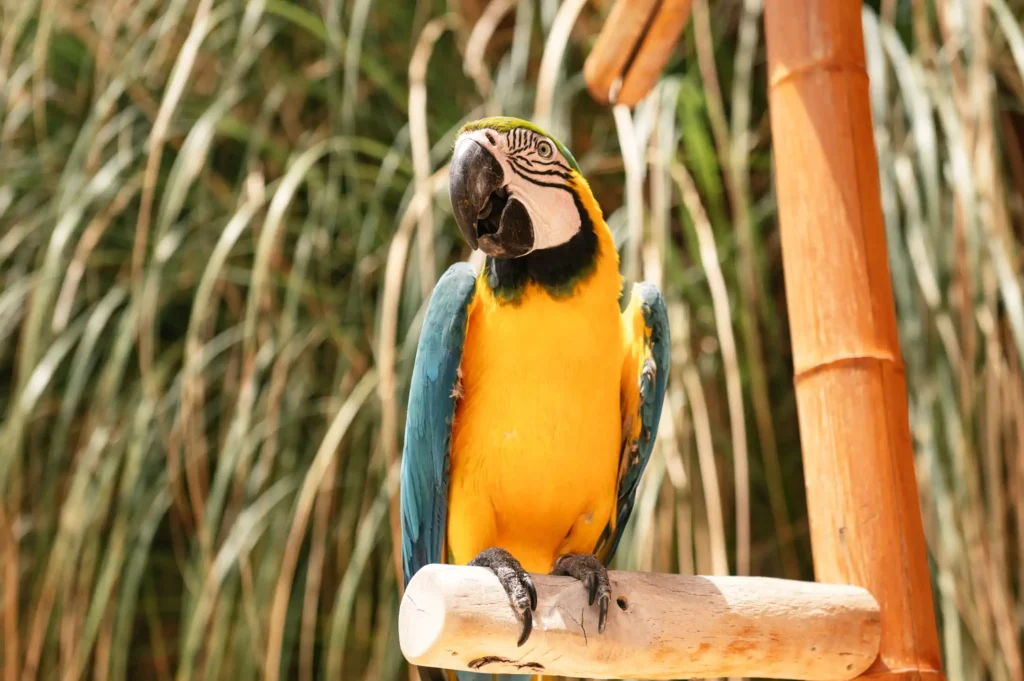
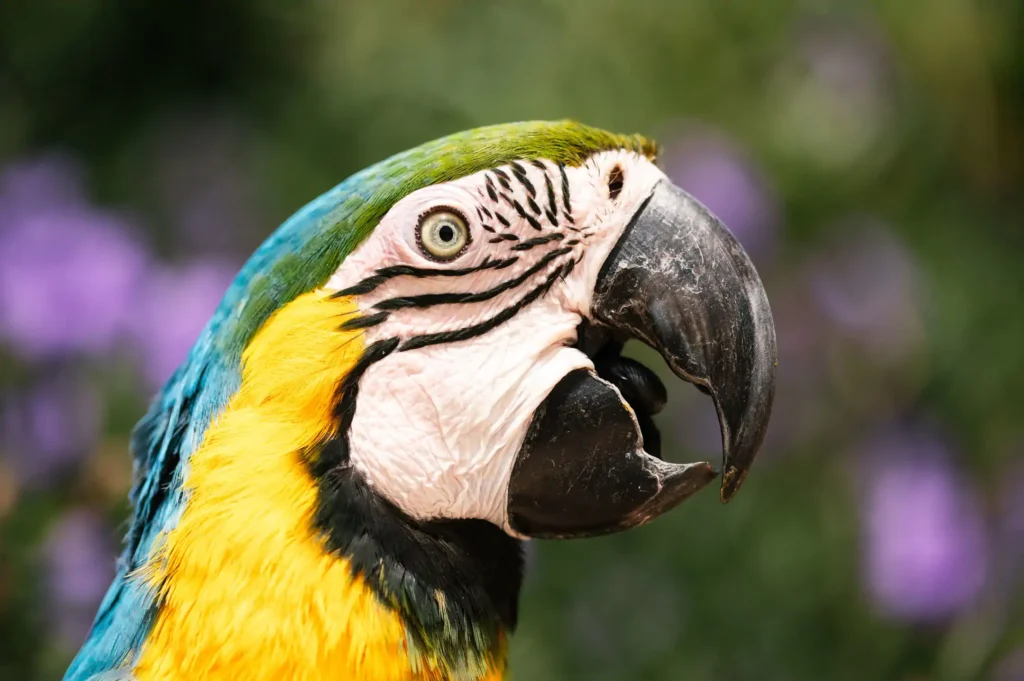
A striking macaw with electric blue plumage on the dorsal part of the body contrasting with the yellow on the ventral part.
Physical Features
They are about 80 cm long, of which the tail accounts for approximately 50%, and weigh between 900-1,100 gr.
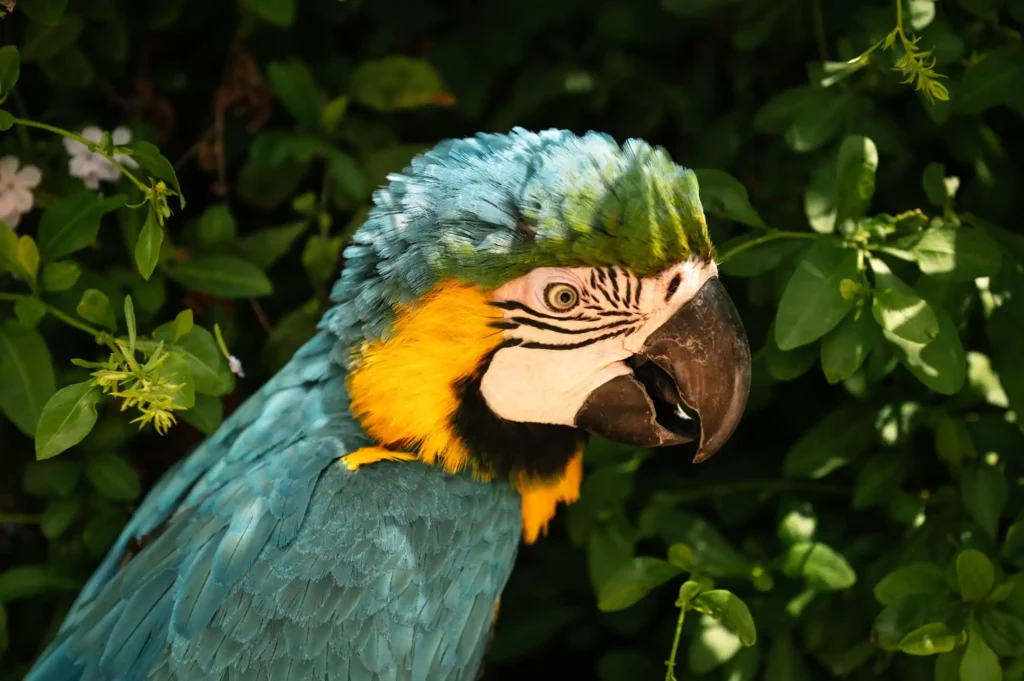
There is no sexual dimorphism, so males and females are similar in appearance: the forehead is green, turning greenish blue. The rest of the upper body is a rich sky-blue, including the underside of the tail.
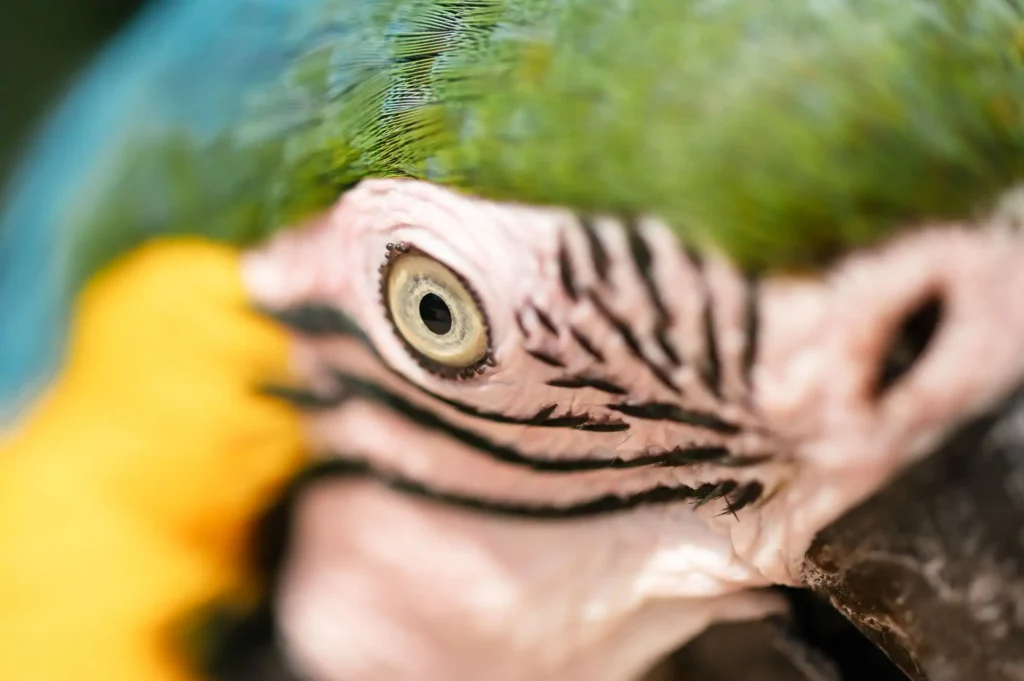
The throat is black, the facial skin is white with a few rows of black feathers bordering the lower edge of the eye. A yellow-orange plumage extends from the ear coverts to the sides of the neck with a greenish ridge often present where it joins the black plumage on the underside of the throat.
Black bill, greyish legs and light-yellow iris. Juveniles can be distinguished from adults by their dark brown iris.
Habitat
Native to South America, their natural habitat runs from eastern Panama, in the extreme south of Central America, through northern Colombia. West of the Andes the blue-and-yellow macaw is only present in the southwestern parts of Ecuador. Also present in the eastern lowlands of this country as well as at similar areas in Peru.
It is found throughout Amazonia, extending northwards into southern Venezuela, Suriname and French Guiana.
The southern part of its habitat extends into the central and north-eastern parts of the interior of Brazil as well as northern Bolivia. It may also be present in Paraguay and possibly in northern Argentina, although this is not known with certainty.
Diet
The diet of macaws is based mainly on seeds (70%) and a much smaller percentage (12-15%) on fruit, with some flowers, buds and nectar completing the diet.
Several studies have identified more than 70 different species of plants from which these birds obtain their food, with a very high percentage of lipids and toxins in this food.
Some examples are: Spondias seeds, Terminalia, Hura, Enterolobium, Inga, Parkia, Platypodium, Quararibea nectar, Combretum flowers, Ficus fruit and/or petioles, Sloanea pulp, Schwartzia, Brosimum, Sorocea.
Reproduction
During the breeding season, between February and June, the blue-and-yellow macaw nests in natural cavities such as hollows in tall trees where they feel more protected.
They usually lay 2-3 eggs with an incubation period of 26-28 days. Once the chicks hatch, weighing 25g, they are reared with strong parental involvement for 65-90 days, until they leave the nest weighing 1kg.
Behaviour
These animals have a strong lifelong bond with their mate, and for this reason, they are usually seen in pairs or small family groups of 4-5 individuals, although occasionally groups of up to 100 individuals may gather together.
During the breeding season, these birds only make short flights to collect food and return to the nest as soon as possible. However, they have a great capacity for flight and even long-distance migratory flights have been recorded outside the breeding season.
Threats
The heavy deforestation suffered by Central and South American forests has led this species to suffer a drastic population decline, which requires urgent measures to conserve this species in the wild.
In addition to deforestation, there is indiscriminate hunting for domestication, breeding and subsequent sale on the black market.
Status and conservation
It is the most common macaw species, but it is nonetheless at some risk due to the threats it faces. This is why it is listed in Appendix II of the CITES Convention.
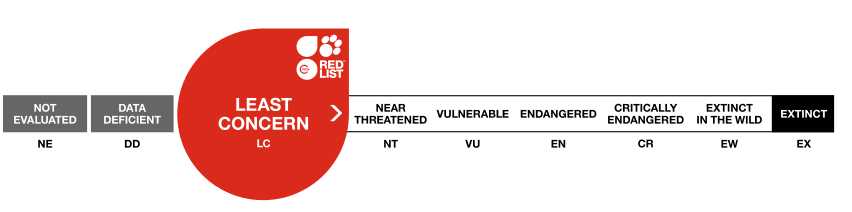
Classified as Least Concern (LC) on the IUCN Red List.